
Mariano Votta and Daniela Quaggia of the Active Citizenship Network discuss the future of vaccination policy, innovation, and patient-centred research to strengthen prevention, public trust, and health resilience across Europe.
Vaccination research is always evolving, harnessing new technologies to help reduce the burden of several diseases or to eliminate them from our communities. Since the first vaccine was developed in 1796, scientists have searched for new ways to protect people against infectious diseases through vaccination.1
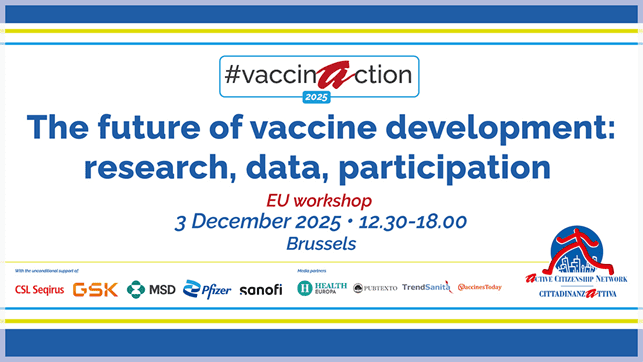
Nowadays, in which direction is research in the field of vaccination policies heading? Why is it necessary to invest in prevention, especially in this historical moment? And what contribution can organised civil society provide? To answer these questions, Active Citizenship Network – the EU branch of the Italian NGO Cittadinanzattiva – has organised an EU workshop in Brussels on 3 December 2025 to explore the next frontiers of vaccine development.
Together with experts and representatives of civil society organisations, the event will explore the key stages of vaccine research and development; innovation and investment priorities, including new platforms (mRNA, DNA) and delivery methods; and approaches for returning data to clinical study participants and actively engaging them in research.
On this last point, drawing on FACILITATE – an Innovative Health Initiative (IHI) project we are involved in, which defines a participant-centred, ethical and legally grounded framework for the Return of Individual Participant Data (RoIPD) from clinical studies – we will brief association leaders from several countries on the approach proposed, ‘by design’, patient-centred and flexible, to return individual data to clinical study participants, illustrating how RoIPD can strengthen trust, improve health literacy and enhance the quality of vaccine research, among the others, across different settings.
The initiative aims to provide accurate information on health innovation, promote a culture oriented towards prevention, and counterbalance the constant references to new pandemics – future scenarios which, while possible, are rarely accompanied by messages about what is being done to prevent them. The risk, in short, is that we speak only of new global threats and never of the advances in research which, in the medical and public health fields, represent the main source of hope for millions of people.
Hence, the decision to focus on research in the field of vaccination policies: an area in which Cittadinanzattiva–Active Citizenship Network has long been engaged in Italy and across Europe to promote a life-long immunisation approach among the population.
Naturally, the topic will be explored not from a product-based perspective but from a public policy perspective. In this regard, it is always important to remember that every year, vaccines save millions of lives around the world. They are one of the most effective tools we have to prevent serious infectious diseases.2 Also for this reason, recently, the Mission Board on Vaccination in Europe – the pan-European coalition of public health experts, patient organisations, civil society leaders, academics, and industry actors in which Active Citizenship Network is member – called for Europe to use the next Multiannual Financial Framework to invest in prevention and immunisation as drivers of Europe’s future competitiveness, productivity, and resilience.
“Vaccination is one of the most powerful and cost-effective tools we have,” said Professor Walter Ricciardi, Chair of the Mission Board on Vaccination in Europe. “It saves lives, strengthens economies, and enables societies to recover and succeed in the face of crisis. Now is the time to double down on prevention“. A message that we embrace and translate into action in accordance with the principles set out by the European Charter of Patients’ Rights, on all the Right to Preventive Measures and the Right to Innovation: “Each individual has the right of access to innovative procedures independently of economic or financial considerations. The health services have the duty to promote and sustain research, paying particular attention to rare diseases. Research results must be adequately disseminated.”
The initiative – as part of the EU project #VaccinAction2025– Protecting the Value of Vaccination Across Europe – is tailored and reserved by invitation to leaders of patients’ associations, Patients’ Advocacy Groups (PAGs), and Civil Society Organizations (CSOs) from different Member States already engaged in the Active Citizenship Network’s initiatives on the topic.
- https://vaccination-info.europa.eu/en/about-vaccines/history-vaccination/whats-pipeline-future-vaccine-development
- ema.europa.eu/en/human-regulatory-overview/public-health-threats/vaccine-preventable-diseases-key-facts/vaccines-concerns-questions-false-claims